
One Month-ish Update
Posted by Andrew on Feb 18, 2026
At the beginning of the update that I wrote about three weeks ago, I said I was going to try to keep up with a two week cadence. You may think that Sophie and I have already failed in that endeavor, but we have a good reason for waiting to write this post, I promise!
Koh Samui
Admittedly, this feels like about a hundred years ago for us. At the end of our last update, we had just gotten back to civilization after spending a night sleeping in a bungalow floating on a lake in a national park. From there, we took a 3 hour van ride to the east coast of Thailand, and then a one hour ferry to the island of Koh Samui.
Koh Samui is famous for its party culture. Sophie and I are not famous for our ability to party. We ended up staying on a part of the island called Mae Nam, which is the northern side of the island. This was the respite that we were looking for, as we practically had the beach to ourselves for two days.
Other than the beach days, we didn’t actually do much on the island. It’s bigger than it looks like it would be on a map, so it’s fairly difficult to get around. Consider this foreshadowing for some lessons learned later on in this post.
The Night Bus to Bangkok
One of the things that I learned about Thailand is that it’s extremely crowded during January. This also means that, unlike a lot of backpacking destinations, it’s actually fairly difficult to have any spontaneous plans. We wanted to take an overnight sleeper train from the city of Surat Thani, which is sort of the main transit hub in the south, to Bangkok. We realized that we were about three months too late in booking this, so we were forced to take an overnight bus instead.
We booked through a website called 12go, which is the primary method that most westerners use to book transit through Southeast Asia. The journey was going to include a 1 hour ferry ride back to the mainland, followed by a 13 hour bus ride overnight.
The ferry was uneventful, though we had clearly chosen The People’s Ferry™️ and not the luxury option. When we arrived in the ferry port, we were told to get onto a wagon with benches that was being towed by a pickup truck. This was supposed to bring us to the bus stop where we could catch our bus to Bangkok.
It brought us to a parking lot, in which a giant tourist bus was parked! We thought that this was surely going to be our bus, but when we showed our ticket to the driver, we were informed that we were to wait for another bus operated by a different company. Thankfully, this parking lot had a covered waiting area with offices of several travel agencies. We waited, but I decided to see what the status of our bus was. I’m fairly certain that one of the most common lies told in Thailand is “yours is the next bus” as we were told this several times over the course of our travel day.
It turned out that ours was not, in fact, the next bus, as a tour van pulled up to the waiting area. The driver popped out of this van, and without any hesitation whatsoever, pointed at Sophie and I to tell us that our bus was actually departing from another bus stop and we were to come with him. You may be thinking that this is clearly an indictment of the American early education system, since we were surely taught not to get into a strange man’s van. But it’s actually fairly common for tour agencies to “collaborate” in getting customers to their desired location. The van was full of other tourists, so we figured we were probably safe.
The van brought us to another tour agency where another tour bus was waiting. However, if you can believe it, we were told that ours was the next bus. The man who told us this has an interesting definition for a bus, because a tuk tuk was actually what pulled up. We were told that the tuk tuk would be bringing us to the bus station.
In the end, we were brought to the public bus station and put on a non-tourist bus to Bangkok. We did make it safely to Bangkok though!
Bangkok
No trip to Thailand is complete without a stop in Bangkok. I personally liked Bangkok quite a bit. It provided us an opportunity to run some errands for things we were obviously lacking. I purchased a sun hoodie and an inflatable travel pillow. Sophie got a refill of her prescriptions.
The best thing that we did in Bangkok was travel an hour north to the old capital of Ayutthaya. There are dozens of 13th and 14th century temples that you can visit. The best part was that it wasn’t overly crowded.
Chiang Mai
Having learned about putting our trust in full-service tourist companies, but still having not booked the train from Bangkok to Chiang Mai three months in advance, we decided to book a night bus through a bus company instead. We ended up being 100% right since this was a completely uneventful bus journey.
Sophie and I both loved Chiang Mai. We spent our days visiting temples, hiking to waterfalls, and finding the best khao soi. On one day, I decided to go to an ethical elephant sanctuary that I actually learned about from the tour company that my mom and I used to go to Antarctica. It is called Elephant Nature Park. It’s essentially a giant reserve in which elephants purchased from circuses and elephant shows spend the rest of their days roaming freely and being taken care of by trained staff. We didn’t get to interact with any of the elephants, which is a good thing, but we got to walk around their reserve. While I was doing this, Sophie went to the Silver Temple to make jewelry.
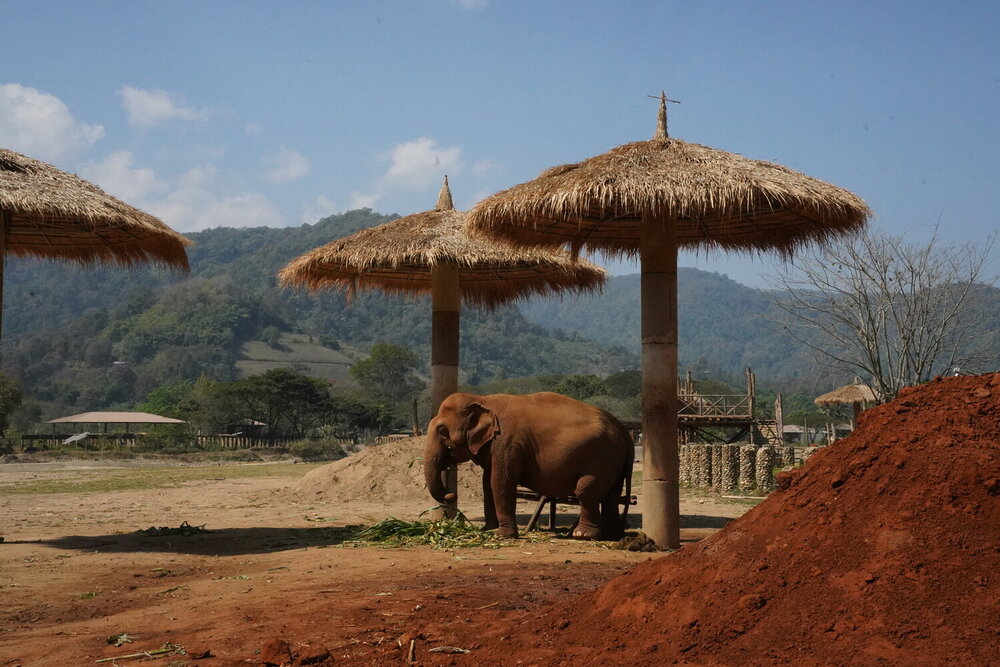
An elephant hanging out in Elephant Nature Park.
We decided that we wanted to a bit off the beaten path to escape the crowds in Thailand, so we ended up traveling an hour outside of Chiang Mai to a small town called Chiang Dao, where we stayed in a beautiful homestay.
You may be surprised to learn that neither Sophie nor I knows how to drive a motorcycle. This ended up being a very notable deficiency in Chiang Dao. We arrived in Chiang Dao thinking that we would be able to hire a driver for the day. Instead, when we got to our homestay and asked our host about it, she was incredibly confused. We were able to successful get a pickup truck taxi, called a songthaew, to take us to a temple built into the mountains as well as a small village where we went on a hike and admired the view. But outside of these excursions, it was very difficult to get around, even for meals.
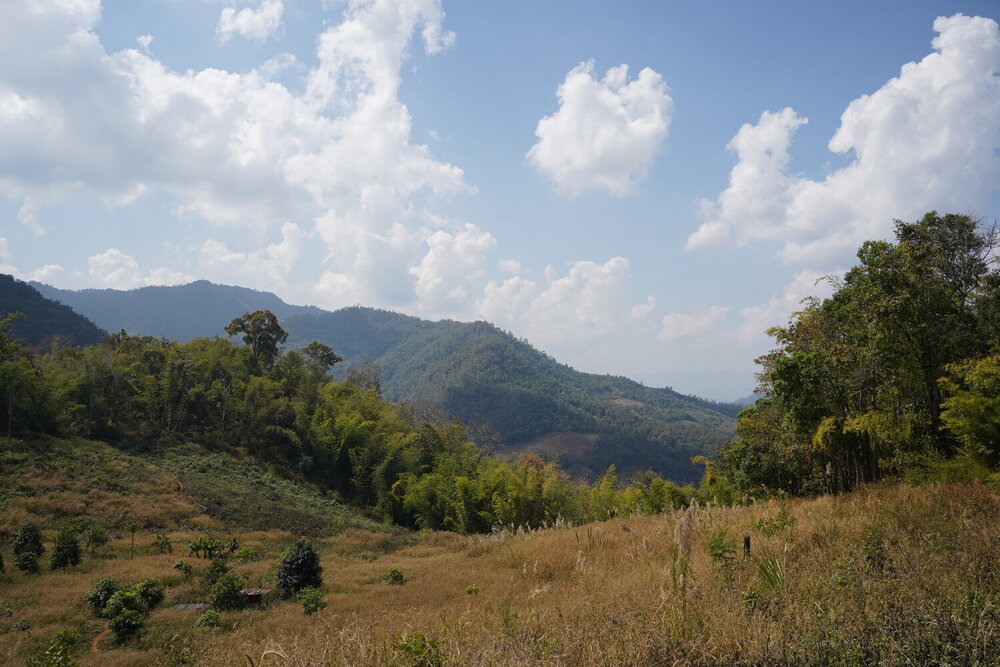
Mountains we saw on our hike in Chiang Dao.
Learning experiences!
Entering Laos
From Chiang Mai, we once again booked a reputable Thai bus company called Green Bus, to take us to the border with Laos. This ended up being a mostly uneventful, save for the bus breaking down and needing to be replaced an hour into the drive, but excruciatingly long journey. After about 10 hours of bus ride, we were dropped off at a random intersection where we were told to get a tuk tuk to take us to the border.
The border is actually the Mekong River. So there is a bridge, which is adorably named “the Friendship Bridge,” with a Thai immigration building on one side and a Lao immigration building on the other side. It’s fairly simple. You go through Thai immigration and get a stamp that said you’ve left Thailand, then you get a bus to take you five minutes to the Lao side, where you apply for a visa on arrival and enter Laos in a town called Huay Xai.
The Gibbon Experience
There are exactly two things to do in Huay Xai. The most common of which is to leave, which we’ll cover later. The most expensive of which is called The Gibbon Experience, which is a 3-day/2-night adventure in the Lao jungle that involves hiking, ziplining, and camping overnight in treehouses that are built over 100 feet above the jungle floor.
The Gibbon Experience is up there with going to Antarctica for the most incredible thing I’ve ever done in my entire life. It’s really indescribable, so I’ll let the pictures and videos speak for themselves.
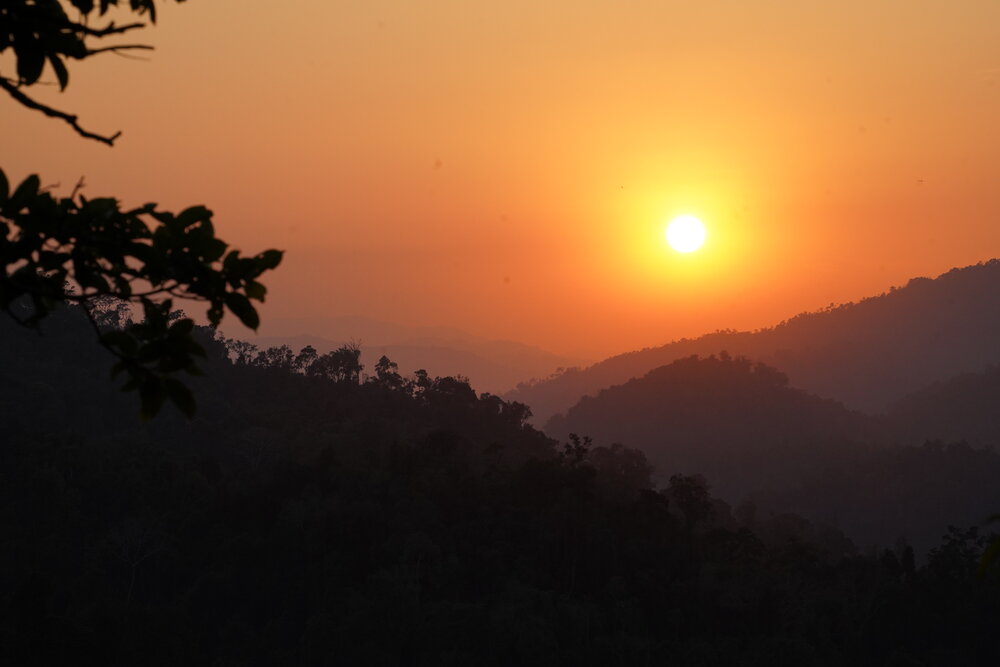
Sunset from our treehouse on the Gibbon Experience.
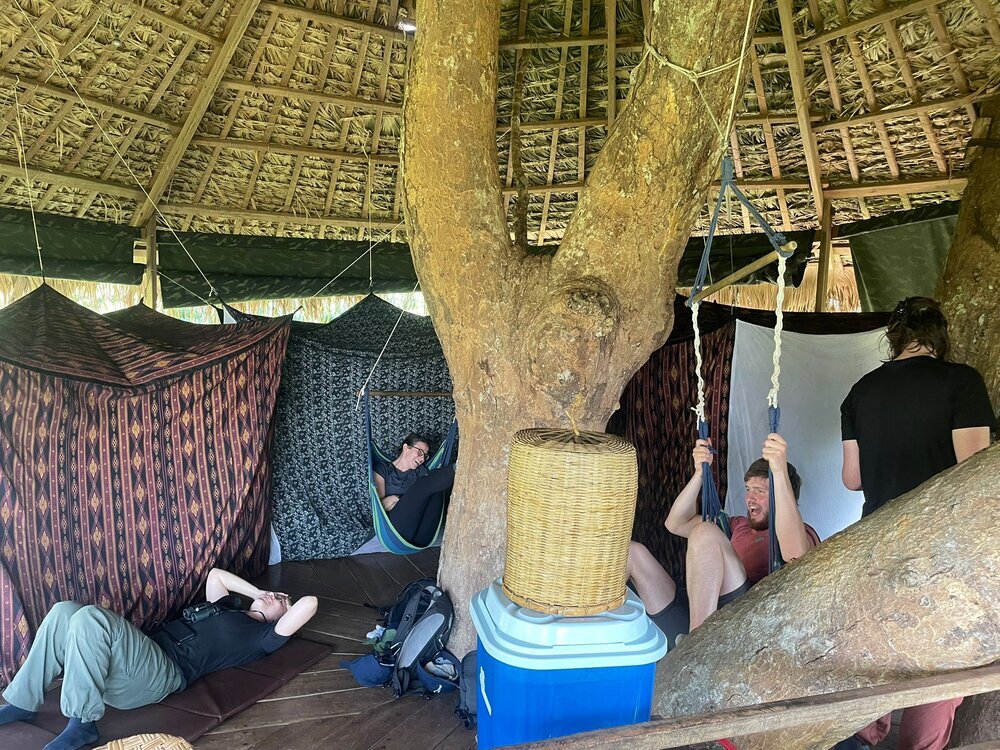
Hanging out in the treehouse during some downtime.
The blankets that you see behind us are where we slept. They are mosquito nets, which proved super helpful, since we were visited in the night by a litany of animals, including: hornets, giant spiders, several mice, a giant squirrel, and potentially bats.
Speaking of treehouses, this was the view as we ziplined out of treehouse in the mornings.
Our treehouse as we ziplined out to start the day.
We spent most of the second day exploring other treehouses. This was one of the ziplines that we took into another treehouse that gives you an indication of just how high we were most of the time!
Ziplining high above the jungle.
The main point of the Gibbon Experience is to see gibbons. You actually only get one opportunity to do this. We woke up around 5am to zipline in the dark out to a small platform near where the gibbons usually nest. There are actually only a handful of gibbons in this reserve since they are critically endangered. We saw them from a distance, but you best believe we heard them!
Hearing the calls of gibbons! Turn your sound on!
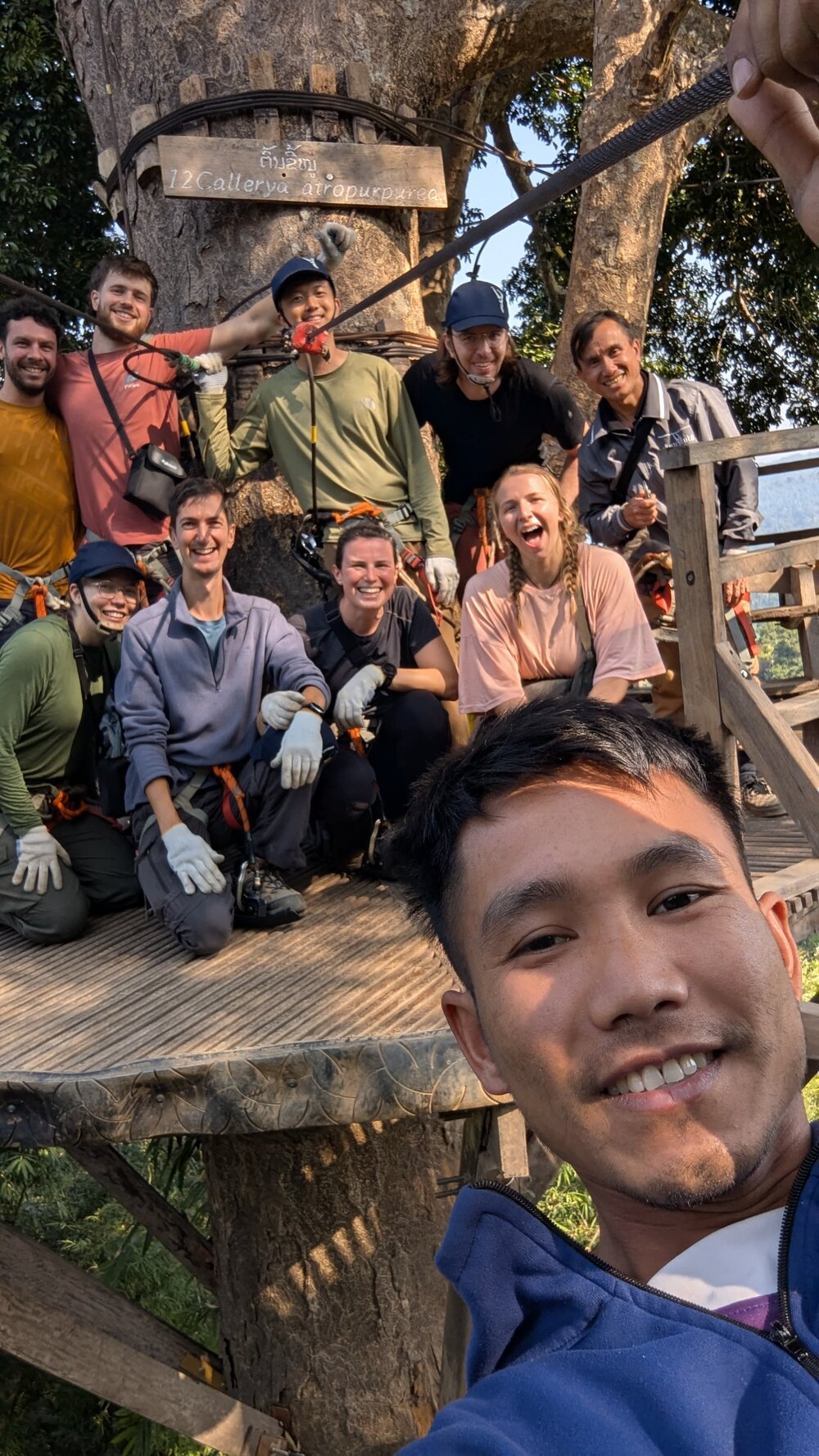
Our group for the Gibbon Experience.
The Slow Boat
As with all great journeys to Huay Xai, you do have to leave it eventually. The most common way to leave is actually by boat, referred to as “the slow boat.”
The slow boat is a two day, one night public boat ride down the Mekong River. It is not luxurious, nor is it comfortable. It is fairly cheap, we paid $35 per person, though I believe you can go as low as $20 if you book directly at the slow boat pier. Ours included a lunch and a tuk tuk ride to the pier.
The big reason that we paid more is that ours was supposed to include a guaranteed front seat. The reason you want to be in the front is that the boat is powered by an incredibly loud and smelly diesel engine that sits at the back of the boat. If you are unlucky enough to sit by the engine, you have to spend 7 hours on the first day with constant noise and diesel fumes.
On the first day, we arrived at the slow boat pier at about 8:30am in preparation for what was supposed to be a 9am departure. We were a bit nervous since we heard that the slow boat is typically very crowded, but when we arrived, there were barely 20 people on the boat.
This peace lasted for about 20 minutes as a large tour bus showed up containing probably about 100 more people. They all boarded, which left the boat mostly full, but no one had to sit too close to the engine.
I was sure that we were about to set off, until a second tour bus arrived at the slow boat pier containing another hundred or so people. Initially, they saw the state of the boat and protested by refusing to board. This did not work. The captain informed them that the two options they had were to stay the night in Huay Xai and buy a totally new ticket for the boat the next day or get on this one. All of them boarded. Suddenly, we were completely full.
A few of the people who were forced to sit in the back of the boat ended up coming up to the front of boat, where we were sitting, and sat on the floor.
The scenery along the Mekong was beautiful, and thankfully, we had about seven hours to take it in before arriving in the first major stop, the town of Pak Beng.
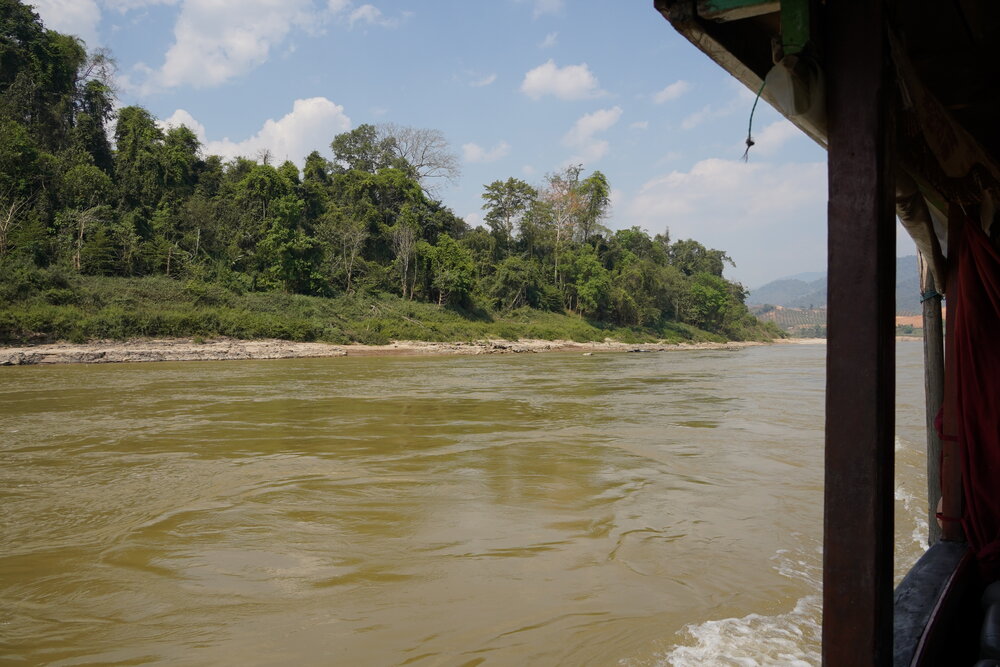
Our view from the first day of the slow boat journey down the Mekong.
Pak Beng is interesting because the town exists basically because the slow boat stops there. There are a ton of restaurants that only serve dinner or to-go breakfast and a ton of guest houses. We ended up staying in an 8-bed dorm room for the night.
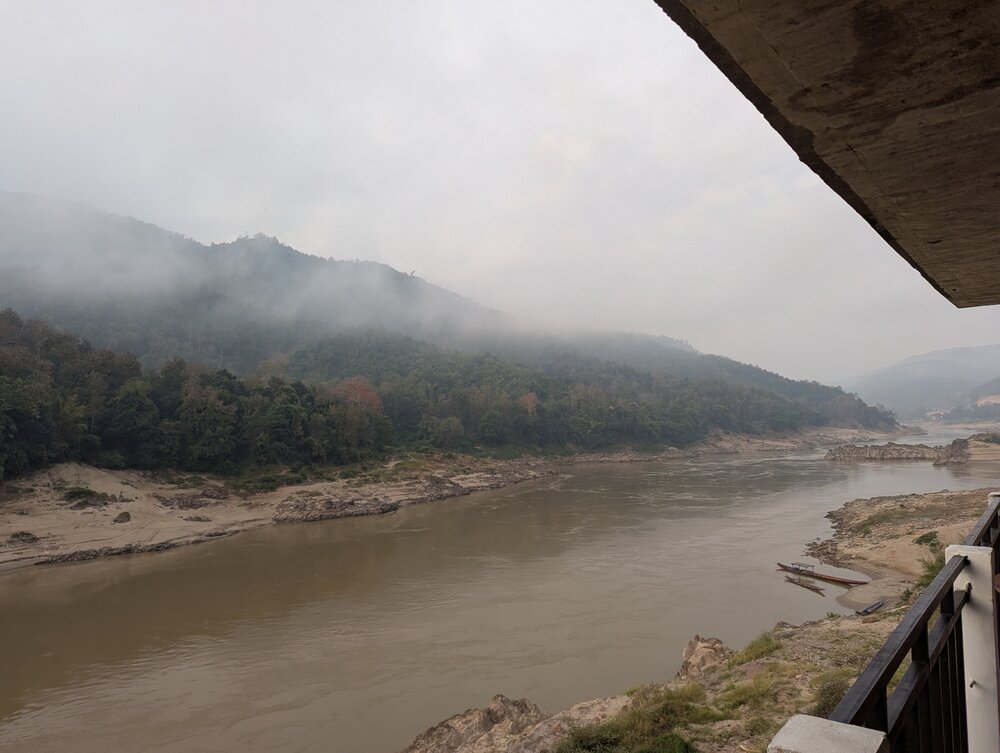
Morning in Pak Beng.
The true chaos of the slow boat arrives early the next morning.
When we were in Chiang Mai, we noticed a ton of places selling tickets that were marketed as a slow boat to Laos. We were confused since Chiang Mai has no river, certainly not one that goes all the way into Laos. It took us a while to work out that it meant that you would take a 6+ hour bus ride to the border where you would get on a boat. I believe a lot of people weren’t exactly clear on this part. So on one side, there were a bunch of people who had both gotten up at 5am the day before to take a long bus ride to an even longer ferry ride. Most of whom were forced to endure seven hours of diesel fumes and engine noise.
On the other side, you had people like us who were sold tickets that supposedly guaranteed seating in hopes of avoiding being forced to endure the diesel fumes and the engine noise.
In the middle, you had a slow boat operator who didn’t really care where anyone was sitting or if anyone had actually made it to the boat.
Both groups of tourists were determined to not have to be in the back of the boat, and the operator was determined not to really care. This meant that tourists started arriving at the boat as early as 7am for a 9:30am departure. Sophie and I hatched a plan where Sophie would acquire food for the day, and I would claim seats on the boat at 7:15am. This plan worked. And actually, the boat on the second day felt a lot more spacious. We don’t know if it’s because the boat was bigger or if people had missed the boat or elected to either take an upgraded boat or bus.
Needless to say, we were able to pass the day watching the Mekong go by and talking to our new friends, Dan and Annie from the UK!
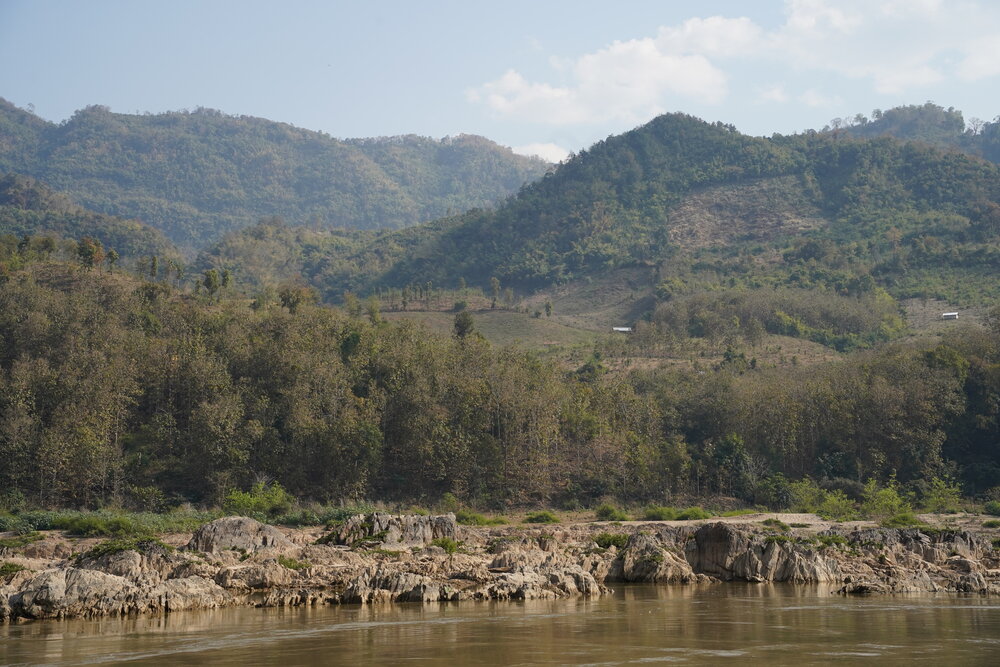
Hills that we saw as we sailed down the Mekong on the second day of our slow boat journey.
After about 8 hours, we arrived at Luang Prabang, where we are currently. We will spend a few days here before moving onto Cambodia.